Learn Irish Phrases That Sound Like a Local
Whether you’re visiting Ireland, connecting with Irish family, or just want to add a bit of Gaelic charm to your speech, a few well-chosen phrases will open doors and smiles. Below are 14 essential Irish (Gaeilge) and Hiberno-English phrases with easy pronunciation, literal meaning, when to use them, and cultural tips.
Quick tips before you start
- Irish (Gaeilge) is its own language; Hiberno-English are English expressions shaped by Irish usage. Both are part of modern Irish life.
- Pronunciations vary by region (Munster, Connacht, Ulster). The phonetic guides here are simple approximations to get you started.
- The fada (´) over a vowel lengthens the sound — for example, “a” vs “á”.
14 phrases to learn now
- Dia dhuit — (DEE-uh GWIT)
- Literal: “God to you”
- Meaning: “Hello”
-
When to use: A friendly, slightly formal Gaelic greeting. Reply: “Dia is Muire dhuit” (DEE-uh iss MCWIR-eh GWIT) — “God and Mary to you.”
-
Conas atá tú? — (CUN-us uh-TAW too)
- Literal: “How are you?”
- Meaning: “How are you?”
-
When to use: Everyday check-in. Common answer: “Tá mé go maith” (taw may guh mah) — “I’m good.” For informal chat, people often say “Cad é mar atá tú?” or simply “All good?”
-
Slán — (SLAWN)
- Literal: “Safe”
- Meaning: “Goodbye” or “farewell”
-
Variations: “Slán go fóill” (see you later), “Slán abhaile” (safe home) — nice to say when someone leaves for home.
-
Go raibh maith agat — (guh rev mah AH-gut)
- Literal: “May there be good at you”
- Meaning: “Thank you”
-
Reply: “Tá fáilte romhat” (taw FAWL-che roh-wut) — “You’re welcome.”
-
Céad míle fáilte — (kayd MEE-luh FAWL-che)
- Literal: “A hundred thousand welcomes”
-
Meaning: A very warm welcome — used in greetings, signs, and formal hospitality.
-
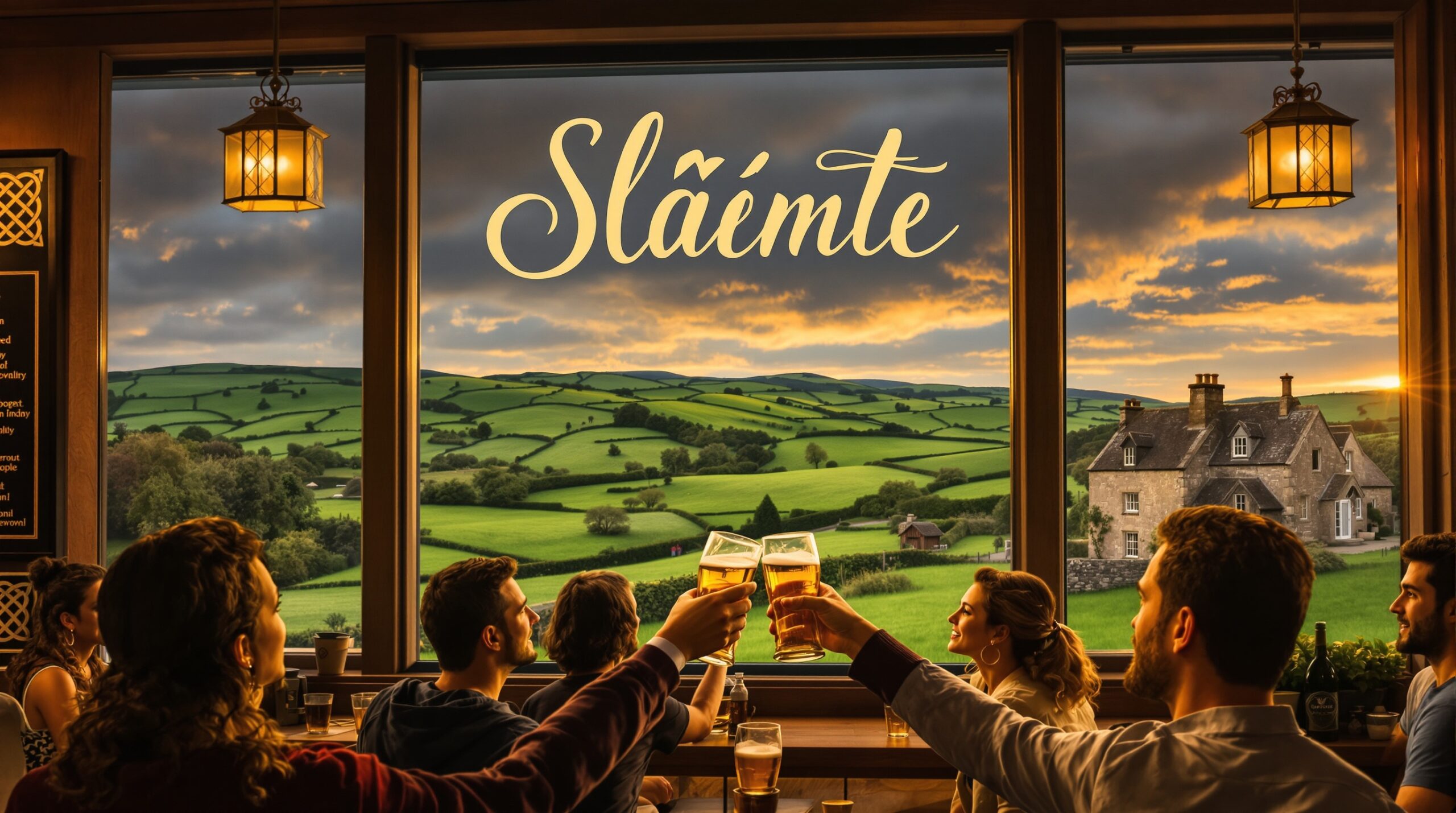
Sláinte — (SLAHN-chuh)
- Literal: “Health”
- Meaning: “Cheers!” — used when clinking glasses.
-
Cultural note: Often followed by “agus” (and) or simply used on its own. Respond with the same word.
-
Craic — (CRACK)
- Meaning: Fun, banter, news. Common phrase: “What’s the craic?” meaning “What’s happening?” or “Any news?”
-
Use: “Good craic” = fun time; essential for social life in Ireland.
-
Le do thoil — (leh duh HIL)
- Literal: “By your will”
- Meaning: “Please”
-
Use: Adds politeness — e.g., “Cabhair, le do thoil” — “Help, please.”
-
Beir bua — (BEHR boo-ah)
- Meaning: “Seize victory” or an encouragement meaning “Good luck” or “Go win it.”
-
Use: Sporting contexts, exams, competitions.
-
Go n-éirí an bóthar leat — (guh ny-REE on BOH-hur lat)
- Literal: “May the road rise with you”
- Meaning: A traditional good-luck/blessing phrase.
-
Is mise… — (iss MISH-eh)
- Literal: “I am”
- Meaning: Use to introduce yourself: “Is mise Niamh” — “I am Niamh.”
-
An bhfuil leithreas ann? — (ahn WILL LEH-hras on?)
- Meaning: “Is there a restroom?”
- Use: Practical phrase for travel; many Irish will understand English, but this is friendly to try.
-
Tá sé go deas bualadh leat — (taw shay guh nyass BOOL-uh lat)
- Literal: “It is nice to meet you”
- Meaning: “Nice to meet you” — warm and polite.
-
Slán agus beannacht — (SLAWN ah-gus BAN-okht)
- Literal: “Goodbye and blessings”
- Meaning: A more formal farewell or blessing.
Short sample dialogues (practice)
- Greeting a friend:
- A: “Dia dhuit! Conas atá tú?”
-
B: “Dia dhuit! Tá mé go maith, go raibh maith agat. Agus tú féin?”
-
Toasting in a pub:
-
“Sláinte!” (everyone clinks glasses) “Sláinte!”
-
Asking politely:
- “Le do thoil, cá bhfuil an siopa?” (Please, where is the shop?)
Pronunciation & cultural notes
- Don’t worry about perfection. The effort to speak a few words is always appreciated.
- Irish has several dialects; pronunciations can change a lot depending on which Gaeltacht (Irish-speaking area) you’re in.
- Many everyday Irish people mix Gaeilge and English freely (code-switching). You’ll hear “What’s the craic?”, then a Gaelic blessing at the end of a conversation.
Common mistakes to avoid
- Treating Irish as “old-fashioned” — it’s a living language used on signs, radio, and by communities across Ireland.
- Mispronouncing fadas: ‘a’ vs ‘á’ can change sound and sometimes meaning.
- Using Gaelic phrases in the wrong tone — e.g., formal blessings in casual contexts can sound odd. When in doubt, greetings, thanks, and “sláinte” are always safe.
How to keep learning
- Listen: RTÉ Raidió na Gaeltachta, YouTube channels, and Forvo for native pronunciations.
- Apps & textbooks: Duolingo, Drops, and phrasebooks like “Buntús” if you want a structured route.
- Practice in context: use phrases in pubs, B&Bs, farmer markets, or with Irish friends. Native speakers appreciate any attempt.
A few simple words — a warm welcome, a short toast, a friendly goodbye — can turn a trip into a memory. Try one of these phrases today: say “Céad míle fáilte” to a stranger, “Sláinte” with new friends, and walk away with an Irish smile. Slán!